Florida Child Support Guide — Income Shares
Florida uses an income-shares model under Fla. Stat. § 61.30. There is no single percentage: the basic obligation comes from the § 61.30(6) guidelines schedule, a dollar table in $50 combined-income steps. That is why this page is a guide with checked examples, not a calculator — and there is a second, specific reason: the schedule steps are $50, and the rounding or interpolation rule for a combined income that falls between two rows is not stated on this page, so a calculator built here would have to guess for most real incomes. Use the schedule rows, the worked examples and the worksheet walkthrough below, and run the court worksheet (Form 12.902(e)) for any real case.
Steps
- Compute each parent's monthly net income: gross income under § 61.30(2)(a) minus the seven allowable deductions in § 61.30(3).
- Add the two net incomes to get combined monthly net income.
- Look up the basic monthly obligation (the minimum child support need) in the § 61.30(6) schedule for that combined income and number of children.
- Each parent's share = their share of combined net income × basic obligation. The parent with less time-sharing generally pays their share to the other parent, before add-ons.
- Add childcare and health costs to the basic obligation and divide them by the same income shares, crediting amounts each parent already paid directly.
- Check whether the gross-up applies: only when each parent exercises at least 20% of the year's overnights (73 nights) for the child.
The schedule — a table, not a formula
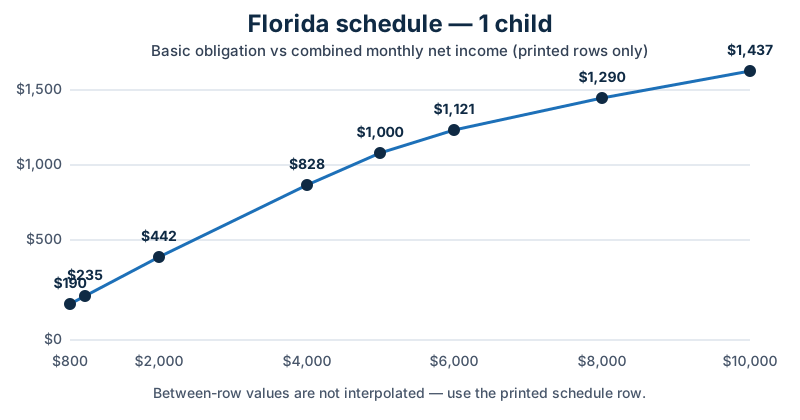
Section 61.30(6) publishes the minimum child support need as a table: combined monthly net income in $50 steps from $800 to $10,000, for 1–6 children. The rows below are taken from the statute text. Find the row for your combined income and number of children — do not apply a percentage to income, and do not extrapolate a row that is not printed.
| Combined monthly net income | 1 child | 2 children | 3 children | 4 children | 5 children | 6 children |
|---|---|---|---|---|---|---|
| $800 | $190 | $211 | $213 | $216 | $218 | $220 |
| $1,000 | $235 | $365 | $397 | $402 | $406 | $410 |
| $2,000 | $442 | $686 | $859 | $968 | $1,054 | $1,128 |
| $4,000 | $828 | $1,288 | $1,603 | $1,816 | $1,982 | $2,119 |
| $5,000 | $1,000 | $1,551 | $1,939 | $2,188 | $2,387 | $2,551 |
| $6,000 | $1,121 | $1,737 | $2,175 | $2,451 | $2,676 | $2,860 |
| $8,000 | $1,290 | $2,004 | $2,513 | $2,827 | $3,085 | $3,298 |
| $10,000 | $1,437 | $2,228 | $2,795 | $3,148 | $3,432 | $3,666 |
Above $10,000 (§ 61.30(6)(b)): the obligation is the $10,000-row figure plus a percentage of the income over $10,000: 1 child 5.0%, 2 children 7.5%, 3 children 9.5%, 4 children 11.0%, 5 children 12.0%, 6 children 12.5%. Below $800: there is no schedule row; the low-income rule below and case-by-case ordering apply instead. Between rows: the schedule steps are $50. This page does not state a rounding or interpolation rule for a combined income between two printed rows — do not assume the nearest row. Follow the Form 12.902(e) worksheet instructions and the court's direction for that case.
How net income is computed
Gross income (§ 61.30(2)(a)) is a wide, non-exhaustive list: salary and wages; bonuses, commissions, allowances, overtime, tips and similar payments; business income (gross receipts minus ordinary and necessary expenses); disability benefits; all workers' compensation benefits and settlements; reemployment assistance and unemployment compensation; pension, retirement or annuity payments; Social Security benefits; spousal support received from a previous marriage or ordered in the marriage before the court; interest and dividends; rental income (gross receipts minus ordinary and necessary expenses); royalties, trusts and estates; reimbursed expenses or in-kind payments to the extent they reduce living expenses; and gains from dealings in property unless nonrecurring. Public assistance as defined in § 409.2554 is excluded from gross income.
Imputation (§ 61.30(2)(b)): income is imputed to a voluntarily unemployed or underemployed parent based on recent work history, occupational qualifications and prevailing community earnings. If a parent's income information is unavailable, the parent fails to participate, or the parent fails to supply adequate financial information, income is automatically imputed with a rebuttable presumption of the median income of year-round full-time workers from U.S. Bureau of the Census reports. Incarceration is not treated as voluntary unemployment. Social Security benefits received by a minor child due to a parent's retirement or disability are included in that parent's gross income.
Allowable deductions (§ 61.30(3)) — subtracted from gross to get net, per parent: (a) federal, state and local income tax deductions, adjusted for actual filing status, allowable dependents and income tax liabilities; (b) FICA or self-employment tax; (c) mandatory union dues; (d) mandatory retirement payments; (e) health insurance payments, excluding payments for coverage of the minor child; (f) court-ordered support for other children actually paid; (g) spousal support paid under a court order from a previous marriage or the marriage before the court.
Worked example — simple case
Parent A net $3,000/month; Parent B net $1,000/month; 1 child; Parent A exercises less than 20% of overnights (Parent B is the primary time-sharing parent); no add-ons, no deviation. Combined net income = $3,000 + $1,000 = $4,000. Schedule row $4,000, 1 child = $828 basic monthly obligation. Shares: A = 3,000/4,000 = 75% → $828 × 0.75 = $621.00; B = 25% → $207.00. Result: Parent A pays Parent B $621/month (Parent A's share; no add-ons included, no deviation applied).
Substantial time-sharing and the gross-up
"Substantial amount of time" means a parent exercises time-sharing at least 20% of the overnights of the year — 73 overnights (§ 61.30(11)(b)). The gross-up applies only when each parent meets that threshold for each child, under a plan, court order or agreement. Below the threshold, the parent exercising time-sharing less than 20% pays the other parent, and the worksheet's gross-up lines are not completed.
Gross-up steps (§ 61.30(11)(b)1–6): (1) compute each parent's apportioned obligation under §§ 61.30(9)–(10) without childcare and health-insurance costs, then multiply by 1.5; (2) compute each parent's percentage of overnight stays; (3) multiply each parent's grossed-up obligation by the other parent's overnight percentage; (4) the difference between those two figures is the monetary transfer, subject to add-on adjustment; (5) compute net childcare and health-insurance amounts owed by each parent under §§ 61.30(7)–(8); (6) credit or debit the transfer by the add-on amounts. The court may then deviate under § 61.30(11)(a), plus three gross-up-specific considerations: the obligee's low income or ability to maintain basic necessities, the likelihood the time-sharing schedule will actually be exercised, and whether all children share the same schedule. A parent's failure to regularly exercise an ordered or agreed schedule (not caused by the other parent) is deemed a substantial change of circumstances, and modification is retroactive to the date of first failure (§ 61.30(11)(c)).
Worked example — substantial time-sharing (gross-up)
Parent A net $3,000/month (60%); Parent B net $2,000/month (40%); 2 children; overnights: A 70%, B 30% (both at or above 20%, so the gross-up applies); no add-ons included. Combined net income = $5,000. Schedule row $5,000, 2 children = $1,551. Basic shares (no add-ons): A = $1,551 × 0.60 = $930.60; B = $1,551 × 0.40 = $620.40. Gross-up × 1.5: A = $930.60 × 1.5 = $1,395.90; B = $620.40 × 1.5 = $930.60. Multiply by the other parent's overnight percentage: A: $1,395.90 × 30% = $418.77; B: $930.60 × 70% = $651.42. Result before add-ons: net transfer $651.42 − $418.77 = $232.65/month, paid by Parent B to Parent A. The higher-earning parent has the child 70% of the time, so the lower-earning parent still pays, but far less than the $620.40 basic share. Add-ons, if any, would then adjust this figure under the worksheet's gross-up lines and are not included here. Near-equal time does not mean $0 — the transfer direction follows the netting, not the higher income.
Worked example — above the schedule
Combined net income $12,000/month; 1 child; shares 50/50; no substantial time-sharing adjustment, no add-ons. Schedule maximum (row $10,000, 1 child) = $1,437. Income over $10,000 = $2,000. 1-child percentage = 5.0% → $2,000 × 0.05 = $100. Total basic obligation = $1,437 + $100 = $1,537/month. Each parent's share at 50% = $768.50. The parent with less than 20% of overnights would pay $768.50 to the other parent (before add-ons and deviation).
Add-ons — childcare and health
Childcare (§ 61.30(7)): childcare costs incurred due to employment, job search, or education (to result in employment or enhance income) are added to the basic obligation; moneys prepaid by a parent for such costs are then deducted from that parent's obligation. Childcare costs may not exceed the level required for quality care from a licensed source. Health (§ 61.30(8)): health-insurance costs for coverage ordered under § 61.13(1)(b), plus noncovered medical, dental and prescription expenses of the child, are added to the basic obligation unless ordered to be paid separately on a percentage basis; moneys prepaid by a parent for health-related costs are then deducted from that parent's obligation.
Worksheet order (Form 12.902(e)): Line 5 = additional support (5a childcare at 100%, 5b the child's health-insurance cost, 5c other, 5d total); Line 6 = each parent's share of Line 5d by the Line 3 percentage; Line 9 = minimum child support obligation for each parent (Line 4 + Line 6 − Line 8, where Line 8 is amounts paid directly). In substantial time-sharing cases the add-ons are layered through the worksheet's gross-up lines instead. Social Security credit (§ 61.30(10)(b)): a parent is entitled to credit for Social Security benefits paid directly to the child or caregiver due to the parent's retirement or disability; if benefits are at least the parent's share, the share is paid in full for that month; if less, the parent owes the difference; excess does not credit arrears or retroactive support predating the benefits.
Low-income rule
Under § 61.30(6)(a), if the obligor parent's net income is less than the amount in the guidelines schedule: (1) the parent should be ordered to pay an amount determined case by case, to establish the principle of payment; (2) the payment is the lesser of the obligor's actual dollar share of the total minimum support and 90% of the difference between the obligor's monthly net income and the current federal poverty guideline (HHS, Federal Register, 42 U.S.C. § 9902(2)) for a single individual living alone. No dollar figure for the current poverty guideline is stated on this page: the guideline changes yearly, so the figure in force at the time of use must be checked before any low-income amount is computed. No low-income dollar example is given here for that reason.
Deviation, end of support, modification
Presumption and ±5% (§ 61.30(1)(a)): the guideline amount presumptively establishes the order. The court may vary ±5% after considering the child's needs, age, station in life, standard of living, and each parent's financial status and ability. A larger variance requires a written finding that the guideline amount would be unjust or inappropriate. The gross-up adjustment (§ 61.30(11)(b)) is mandatory whenever its conditions are met, notwithstanding the ±5% limits.
Deviation factors (§ 61.30(11)(a)) include: extraordinary medical, psychological, educational or dental expenses; independent income of the child (excluding SSI); payment of support for a parent regularly paid with demonstrated need; seasonal variations in either parent's income or expenses; age of the child and greater needs of older children; special needs, including disability costs traditionally met within the family budget even if support then exceeds the guideline; total available assets of obligee, obligor and child; impact of the IRS Child & Dependent Care Tax Credit, Earned Income Tax Credit, dependency exemption and waiver (the court may order a waiver if the paying parent is current); a schedule application requiring a person to pay more than 55% of gross income for current support under a single order; the parenting plan and time-sharing arrangement — including a child spending significant but less than 20% of overnights with one parent, or a parent's refusal to be involved in the child's activities; and any other adjustment needed for an equitable result, including reasonable and necessary existing expenses and debts, including debts jointly incurred during the marriage.
End of support: support is for a minor child, or a child dependent in fact aged 18–19 who is still in high school, performing in good faith with a reasonable expectation of graduation before age 19. Modification: guidelines alone prove a substantial change only if the difference between the existing monthly obligation and the guideline amount is at least 15% or $50, whichever is greater. For orders reviewed by the Department under § 409.2564(11), a difference of at least 10% but not less than $25 triggers a department modification action without proof of a change in circumstances. Subsequent children (§ 61.30(12)): generally not a basis to disregard the schedule; a parent may raise subsequent children only as a deviation justification in an upward modification proceeding, and then the other parent of the subsequent children has their income considered; it may never justify decreasing an existing award.
Worksheet walkthrough — Form 12.902(e)
Every case where child support is requested uses Florida Family Law Rules of Procedure Form 12.902(e), the Child Support Guidelines Worksheet. Standard path: Line 1 = each parent's net monthly income (from Financial Affidavit Form 12.902(b)/(c), line 27, Section I); Line 2 = basic monthly obligation from the schedule; Line 3 = percentage of financial responsibility; Line 4 = share of basic obligation; Line 5 = additional support (childcare, health insurance, other); Line 6 = each parent's share of additional support; Line 8 = amounts paid directly; Line 9 = minimum child support obligation for each parent. Gross-up path: Lines 10–21, used only when each parent meets the 20% overnight threshold. Florida has no official state online calculator; the worksheet is the court-approved instrument. Work through it line by line with the schedule row for your combined income — do not skip from combined income straight to a payment figure.
Department of Revenue — Child Support Program
The Florida Department of Revenue Child Support Program establishes, enforces and modifies child support orders. It locates parents, establishes paternity, establishes medical and financial orders, enforces orders (including income deduction and tax-refund intercept) and modifies orders. It does not enforce visitation or custody, and it charges no fee for its services. A parent may ask the Program to review an order on proof of a substantial, permanent and involuntary change (Program Rule 12E-1.041, Florida Administrative Code). Court filings, unlike DOR services, may carry county filing fees — no single filing-fee figure is published on this page.
Sources: Fla. Stat. § 61.30 (model, gross-income list, deductions, schedule rows, above-$10,000 percentages, low-income rule, add-ons, deviation factors, gross-up, end of support, modification thresholds); Florida Family Law Rules of Procedure Form 12.902(e) (worksheet lines); Fla. Admin. Code Rule 12E-1.041 (DOR review). § 61.30 text (mirror) · § 61.30 text (FindLaw, updated 1 Jan 2025) · Florida Department of Revenue Child Support Program · Eleventh Judicial Circuit FAQ (DOR services)
How to use this guide
Work in the worksheet's order, not from a single number. First, compute each parent's net monthly income from the gross list and the seven deductions — do not start from take-home pay, which already subtracts items Florida does not deduct. Second, add the two net incomes and find the schedule row for that combined figure and number of children; if your combined income falls between two $50 rows, do not guess a rounding rule — follow the Form 12.902(e) instructions for that case. Third, split the basic obligation by income shares. Fourth, add childcare and health costs and divide them the same way, crediting amounts already paid directly. Fifth, check the gross-up: only if each parent has at least 73 overnights does the ×1.5 gross-up path apply. Finally, read the deviation and modification rules before treating any figure as final — the guideline is the presumptive starting point, not the order itself.
Worked examples in a table
| Case | Combined monthly net income | Schedule basic obligation | Result |
|---|---|---|---|
| Simple, 1 child, no substantial time-sharing | $4,000 | $828 | Higher-earning parent (75%) pays $621/month |
| Substantial time-sharing, 2 children, gross-up | $5,000 | $1,551 | Net transfer $232.65/month (lower-earning parent to higher-earning parent, before add-ons) |
| Above the schedule, 1 child, 50/50 shares | $12,000 | $1,537 ($1,437 + 5% × $2,000) | Each share $768.50; parent with under 20% overnights pays $768.50 |
Common mistakes
- Using gross income. Florida starts from net income: gross minus the seven § 61.30(3) deductions. Take-home pay is not the same figure, and gross income overstates the obligation.
- Using a percentage. Florida has no child-support percentage. The basic obligation comes from the § 61.30(6) schedule table; a percentage of income is not the guideline.
- Applying the gross-up when only one parent meets the threshold. The gross-up requires each parent to have at least 73 overnights for the child. If only one parent does, the standard path applies.
- Assuming equal time means $0. Under the gross-up, the transfer is the net of the two grossed-up, overnight-weighted shares. An income gap still produces a payment, as the $232.65 example shows.
- Extending the schedule above $10,000 as if it continued. Above $10,000 the obligation is the $10,000-row figure plus the stated percentage of the excess — 5.0% for 1 child, 7.5% for 2, 9.5% for 3, 11.0% for 4, 12.0% for 5, 12.5% for 6. There is no further schedule row to read.
- Guessing between $50 rows. The schedule steps are $50. This page states no rounding or interpolation rule for a combined income between rows — follow the worksheet instructions for that case instead of assuming the nearest row.
- Forgetting add-ons or double-counting them. Childcare and health costs are added to the basic obligation and divided by income shares, with amounts already paid directly credited back. Prepaid amounts are a credit, not an extra charge.
How courts deviate
Florida courts start from the guideline amount and may vary it by ±5% after considering the child's needs, age, station in life, standard of living, and each parent's financial status and ability. A larger variance needs a written finding that the guideline amount would be unjust or inappropriate, and the court weighs the § 61.30(11)(a) factors listed above — extraordinary expenses, the child's own income, seasonal income variation, special needs, total available assets, tax-credit effects, the 55%-of-gross-income ceiling for a single order, the parenting plan, and any other adjustment needed for an equitable result. The gross-up, where its conditions are met, is mandatory and is not itself a deviation. Show the schedule figure first, then the factors that could move it — that is the order the court itself follows.
When to hire a lawyer
Talk to a Florida-licensed attorney before relying on a schedule figure if income must be imputed, if either parent is self-employed or has variable or seasonal income, if time-sharing is near the 73-night threshold or the schedule is disputed, if the case is above the $10,000 schedule ceiling, if a deviation beyond ±5% is sought, or if a DOR modification is contested. This site cannot recommend a specific lawyer and does not take referral fees.
Frequently asked questions
These questions are shown on the page in full. They are not marked up as FAQ structured data.
Why is there no Florida child support calculator on this page?
Because the guideline is a schedule table in $50 steps, and the rounding or interpolation rule for a combined income between two rows is not stated here. A calculator would have to guess for most real incomes. This guide shows the method, the schedule rows and checked examples instead, and the court worksheet (Form 12.902(e)) remains the instrument for a real case.
What if our combined income falls between two schedule rows?
Do not assume the nearest row. The schedule steps are $50 and this page states no rounding rule for between-row incomes. Follow the Form 12.902(e) worksheet instructions and the court's direction for that case.
Does 50/50 time-sharing mean no child support?
No. Under the gross-up, each parent's share is multiplied by 1.5 and then by the other parent's overnight percentage, and the difference is the transfer. An income gap still produces a payment, as the worked gross-up example shows.
Does the Department of Revenue charge for child support services?
No fee is charged for DOR Child Support Program services. Court filings may separately carry county filing fees, which vary by county and are not stated on this page.
Change log
| Date | Change |
|---|---|
| October 2026 | Initial build: § 61.30 income-shares model, schedule sample rows, gross-up method, add-ons, deviation and modification rules, three recomputed worked examples. Guide only — no calculator, because the schedule is a table and the between-row rounding rule is unverified. |
Related
Other pages for the same jurisdiction or the same topic: